
Calorie Calculator
Clinical metabolic BMR, TDEE, fat loss deficits & macro targets.
Calorie Calculator — Science-Backed Caloric Targets & Deficit Guide
Understanding Energy Balance: Calories In vs. Calories Out
Your body is a thermodynamic system governed by the law of energy conservation. Energy cannot be created or destroyed—only transferred or stored. To maintain stable body weight, the calories you consume through food and beverages (Calories In) must equal the total number of calories your body expends across 24 hours (Calories Out / Total Daily Energy Expenditure).
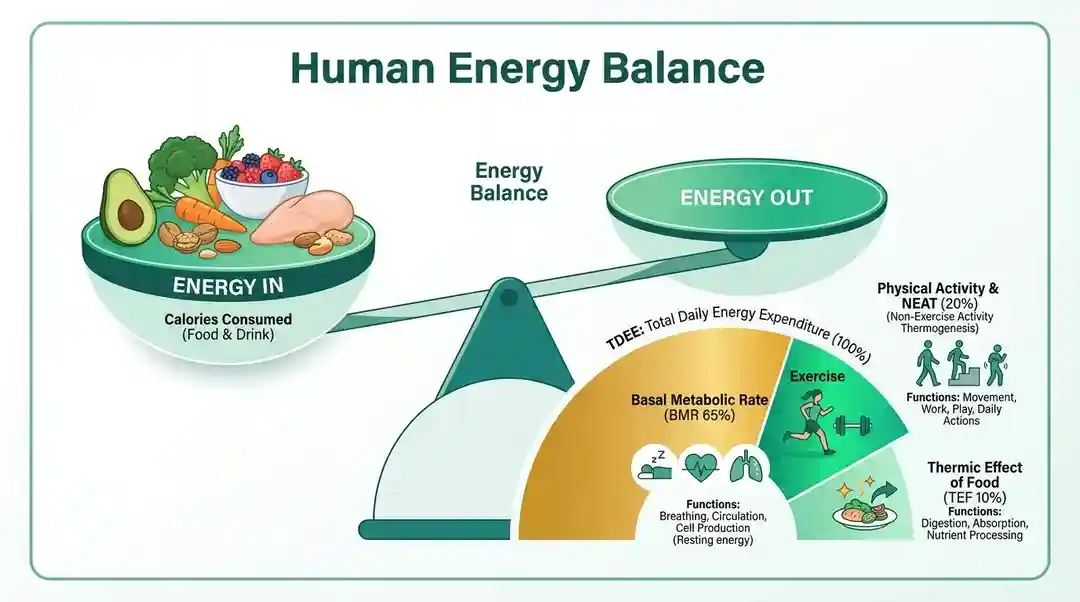
Total Daily Energy Expenditure (TDEE) comprises four distinct physiological components:
- Basal Metabolic Rate (BMR, 60–70% of burn): The foundational calories expended maintaining cellular homeostasis, respiratory breathing, blood circulation, autonomic nervous signaling, and organ function in a fasted, thermo-neutral resting state.
- Non-Exercise Activity Thermogenesis (NEAT, 15–20% of burn): Calories burned through spontaneous daily movement outside intentional exercise—including walking the dog, typing, household chores, pacing, and fidgeting.
- Exercise Activity Thermogenesis (EAT, 5–10% of burn): Energy burned during structured physical conditioning, athletic resistance workouts, running, cycling, or high-intensity interval training (HIIT).
- Thermic Effect of Food (TEF, ~10% of burn): The metabolic energy required by the gastrointestinal tract to break down, digest, absorb, and assimilate dietary proteins, carbohydrates, and fats. Protein possesses the highest thermic effect (20–30% of its caloric value burned during digestion), compared to carbohydrates (5–10%) and fats (0–3%).
The Three Clinical Metabolic Formulas Explained
Our free calorie calculator features the world's three leading predictive metabolic equations used in clinical dietetics and sports physiology:
1. Mifflin-St Jeor Equation (Recommended Gold Standard)
Endorsed by the Academy of Nutrition and Dietetics (AND) as the most reliable formula for healthy adults:
- Men:
BMR = (10 × weight in kg) + (6.25 × height in cm) − (5 × age in years) + 5 - Women:
BMR = (10 × weight in kg) + (6.25 × height in cm) − (5 × age in years) − 161
2. Revised Harris-Benedict Equation (1984 Roza & Shizgal)
A statistical re-evaluation of the classic 1919 equation, widely utilized in hospital settings:
- Men:
BMR = 88.362 + (13.397 × weight in kg) + (4.799 × height in cm) − (5.677 × age) - Women:
BMR = 447.593 + (9.247 × weight in kg) + (3.098 × height in cm) − (4.330 × age)
3. Katch-McArdle Formula (Body Fat & Athletic Precision)
Unlike equations that rely solely on total weight, Katch-McArdle calculates BMR directly from Lean Body Mass (LBM). This avoids underestimating caloric needs in muscular bodybuilders or overestimating needs in individuals with higher adiposity:
LBM (kg) = Weight (kg) × (1 − (Body Fat % / 100))BMR = 370 + (21.6 × LBM in kg)
How Many Calories for 1 kg or 1 lb of Weight Loss?
In human adipose tissue, 1 kilogram of fat stores approximately 7,700 kcal (equivalent to 3,500 kcal per pound). To shed body fat sustainably:
- Standard Fat Loss (−0.5 kg / −1 lb per week): Maintain a daily calorie deficit of
500 kcal/day(3,500 kcal weekly deficit). This is the gold-standard recommendation from the USDA and Mayo Clinic for fat loss without lean muscle wasting. - Mild Fat Loss (−0.25 kg / −0.5 lb per week): Maintain a daily calorie deficit of
250 kcal/day. Ideal for individuals already near their goal weight or athletes in high-performance training cycles. - Aggressive Fat Loss (−1.0 kg / −2.0 lbs per week): Requires a daily calorie deficit of
1,000 kcal/day. Only suitable for individuals with higher initial BMI and under nutritional supervision to avoid micronutrient deficiencies.
Mayo Clinic Clinical Safeguards: Minimum Calorie Baselines
The Mayo Clinic emphasizes that safe caloric restriction must never drop below foundational biological minimums:
- Adult Females: Do not consume fewer than 1,200 calories/day.
- Adult Males: Do not consume fewer than 1,500 calories/day.
Diets falling below these thresholds induce acute adaptive thermogenesis (where thyroid hormones T3/T4 drop and resting metabolic rate declines sharply), gallbladder sludge or stone formation, hair thinning, chronic fatigue, and loss of lean cardiac and skeletal muscle mass.
Macronutrient Composition & Muscle Preservation
Calories dictate weight change, but macronutrient ratios dictate body composition change (fat loss vs. muscle loss).

- Dietary Protein (4 kcal/gram): Essential during caloric restriction. Aim for 1.6 to 2.2 g per kg of bodyweight (0.73–1.0 g/lb). High protein stimulates muscle protein synthesis (MPS) via leucine, minimizes nitrogen loss, and reduces appetite by stimulating satiety peptides (PYY and GLP-1).
- Carbohydrates (4 kcal/gram): The primary fuel for central nervous system function and high-intensity muscular glycogen replenishment. Focus on nutrient-dense complex carbs (quinoa, oats, sweet potatoes, legumes, and berries).
- Dietary Fats (9 kcal/gram): Crucial for steroid hormone synthesis (testosterone, estrogen), fat-soluble vitamin absorption (A, D, E, K), and cellular membrane integrity. Never drop dietary fats below 20% of total daily energy intake.
Why Calorie Cycling (Zigzag Dieting) Works
Prolonged uninterrupted caloric restriction signals biological starvation, downregulating leptin (the satiety hormone) while increasing ghrelin (the hunger hormone). 7-Day Zigzag Calorie Cycling introduces two higher-calorie 'refill' days (typically scheduled on heavy training days or weekends) alongside five moderate deficit days. This undulating pattern maintains thyroid output, restores liver glycogen, reduces binge triggers, and sustains long-term dietary compliance while producing the exact same weekly cumulative fat loss.
Comprehensive Fitness Goal Reference Matrix
| Fitness & Body Goal | Daily Caloric Delta | Target Weekly Rate | Clinical Focus & Guidance |
|---|---|---|---|
| Weight Maintenance | 0 kcal (TDEE baseline) | Weight remains constant | Optimal for body recomposition, metabolic recovery, and athletic maintenance. |
| Mild Fat Loss | −250 kcal/day | −0.25 kg (−0.5 lb) / week | Gentle, highly sustainable; prevents strength losses and hormonal disruption. |
| Standard Fat Loss (Recommended) | −500 kcal/day | −0.50 kg (−1.0 lb) / week | The gold-standard rate recommended by Mayo Clinic and USDA dietary guidelines. |
| Fast Fat Loss | −750 kcal/day | −0.75 kg (−1.5 lbs) / week | Requires elevated protein (>2.0 g/kg) and resistance training to spare muscle. |
| Aggressive Deficit | −1,000 kcal/day | −1.00 kg (−2.0 lbs) / week | Maximum safe clinical rate; must remain above the 1,200/1,500 kcal floor. |
| Lean Muscle Bulking | +250 kcal/day | +0.25 kg (+0.5 lb) / week | Supports progressive overload and muscle synthesis while minimizing fat gain. |
| Muscle Hypertrophy | +500 kcal/day | +0.50 kg (+1.0 lb) / week | Ideal for hardgainers and athletes in intense off-season muscle building phases. |
Frequently Asked Questions
Calculating daily calories requires two steps: (1) Find your Basal Metabolic Rate (BMR)—the energy burned resting in bed—using the Mifflin-St Jeor formula based on your sex, age, weight, and height. (2) Multiply your BMR by your Physical Activity Factor (PAL: 1.2 for sedentary up to 1.9 for extra active) to calculate Total Daily Energy Expenditure (TDEE). To lose weight sustainably, subtract 500 calories per day to lose roughly 0.5 kg (1 lb) per week.
Human body fat tissue contains approximately 7,700 calories per kilogram (or 3,500 calories per pound). To lose 1 kg of pure fat, you need a cumulative deficit of 7,700 kcal over time. A daily deficit of 500 kcal creates a 3,500 kcal weekly deficit, producing approximately 0.5 kg (1 lb) of fat loss every 7 to 10 days.
BMR (Basal Metabolic Rate) is the bare minimum energy your body requires to maintain involuntary life-support functions (heartbeat, brain activity, cellular repair, breathing) at total rest. TDEE (Total Daily Energy Expenditure) is the total calories you burn across 24 hours, combining BMR (60–70%), spontaneous movement (NEAT, 15–20%), exercise (5–10%), and digesting meals (TEF, ~10%).
The Mayo Clinic and international health guidelines advise against eating below 1,200 calories/day for adult females and 1,500 calories/day for adult males without physician supervision. Extremely low caloric intake starves the body of vital vitamins, minerals, and essential fatty acids, triggers gallstones, damages thyroid function, slows resting metabolism, and burns active skeletal muscle.
For most adults, the Mifflin-St Jeor formula is considered the gold standard with the lowest error margin in peer-reviewed dietetics research. However, if you are a lean athlete or strength trainer with a known body fat percentage, the Katch-McArdle formula is superior because it calculates your metabolic burn exclusively from Lean Body Mass (LBM).
Calorie cycling (zigzag dieting) undulates your daily caloric intake throughout the week while maintaining your desired weekly average deficit. Having higher-calorie 'refill' days on demanding workout days and lower-calorie days on rest days supports workout performance, prevents leptin drop-offs, and provides mental relief from continuous caloric restriction.
During a caloric deficit, sports nutrition guidelines recommend consuming 1.6 to 2.2 grams of protein per kilogram of body weight (0.73 to 1.0 grams per pound). Ample protein prevents catabolic muscle loss, maximizes the thermic effect of food (TEF), and increases satiety hormones to keep hunger in check.
Clinical & Nutritional Disclaimer
This calorie calculator provides evidence-based estimates derived from peer-reviewed predictive equations (Mifflin-St Jeor, Harris-Benedict, Katch-McArdle). Individual metabolism varies based on genetics, medications, endocrine health, and body composition. Always consult a registered dietitian (RD) or physician before initiating significant dietary caloric restriction.