
Tip Calculator & Bill Splitter
Calculate tips accurately, split bills per person, handle pre-tax subtotal, and round up for easy cash or mobile payments.
Tip Calculator — Complete Dining, Delivery & Bill Splitting Guide
Whether dining out at a fine-dining establishment, ordering takeout through a delivery app, or splitting a cocktail tab with colleagues, calculating the appropriate tip and dividing the bill fairly can quickly become confusing. Tipping is not only a customary reward for attentive service; in many jurisdictions, it constitutes a vital component of service workers' living wages. CalculatorsDaily’s modern Tip Calculator & Bill Splitter eliminates guesswork by providing real-time pre-tax calculations, custom percentage presets, multi-currency support, and smart rounding options optimized for cash and peer-to-peer mobile apps.
The Mathematics of Tipping & Fair Bill Splitting
At its mathematical core, computing a gratuity and splitting an expense among group diners involves straightforward linear arithmetic. The essential formulas governing our calculation engine are:
Grand Total ($) = Subtotal + Sales Tax + Tip Amount
Total Per Person ($) = Grand Total ÷ Number of Diners
Tip Per Person ($) = Tip Amount ÷ Number of Diners
Effective Tip Rate (%) = (Tip Amount ÷ Subtotal) × 100
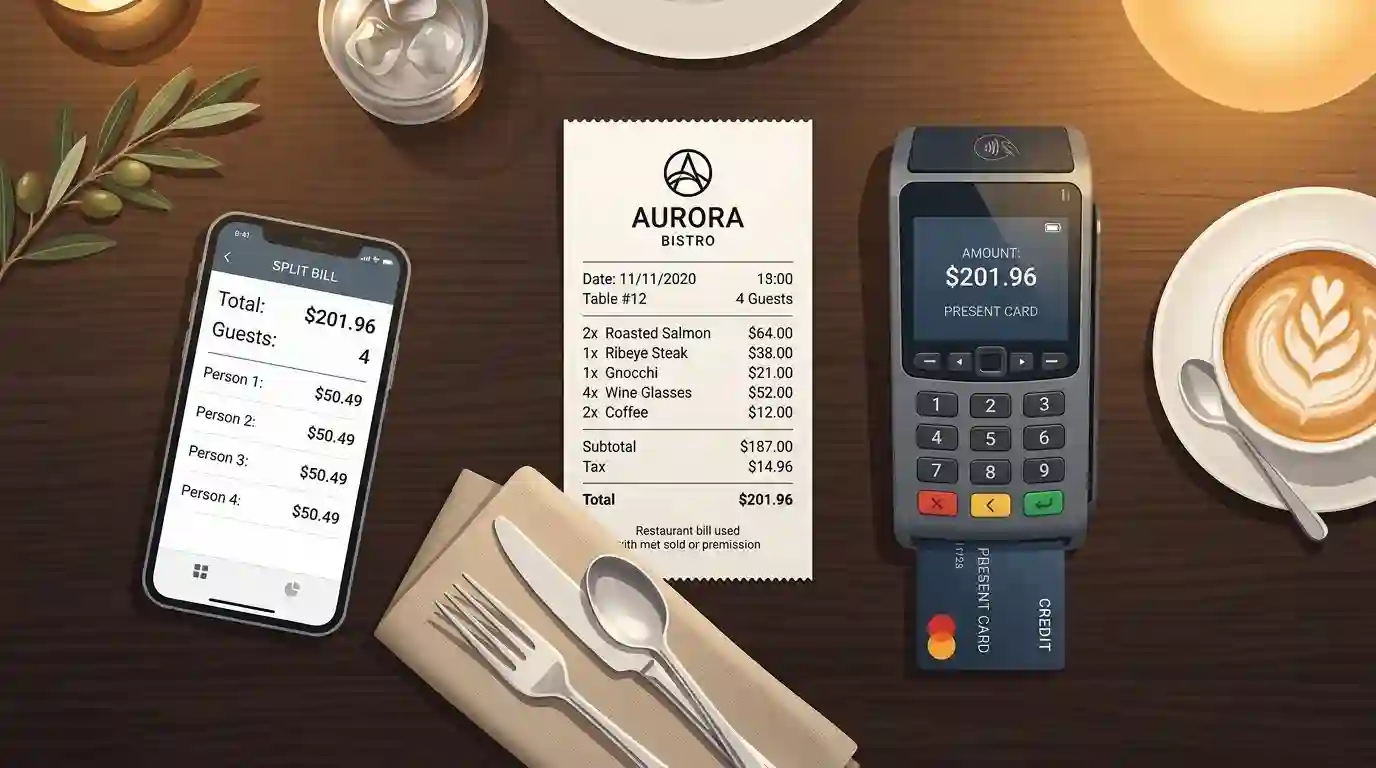
Step-by-Step Calculation Example: Consider a party of 4 diners in a city with an 8.875% sales tax rate. Their food and drink subtotal is exactly $150.00, and they agree on an 18% tip for excellent hospitality:
- Calculate the Tip: $150.00 × 0.18 = $27.00.
- Calculate Sales Tax: $150.00 × 0.08875 = $13.31.
- Sum the Grand Total: $150.00 (Subtotal) + $13.31 (Tax) + $27.00 (Tip) = $190.31.
- Divide by 4 Diners: $190.31 ÷ 4 = $47.5775 (exact share: $47.58 per person).
- Apply Smart Rounding: Selecting Round Per Person Up raises each share to an even $48.00, generating a total pool of $192.00. The surplus $1.69 gracefully covers the bill and boosts the server’s effective tip to $28.69 without anyone needing coins.
The Pre-Tax vs. Post-Tax Tipping Debate
One of the most frequent dilemmas encountered by diners is whether the tip percentage should be calculated on the pre-tax subtotal or the post-tax total. Authoritative etiquette authorities—including the Emily Post Institute, the National Restaurant Association, and consumer advocacy bodies—unanimously recommend calculating gratuities on the pre-tax food and beverage subtotal.
Sales tax is an obligatory government levy, not a personal service rendered by the culinary or wait staff. When you tip on the post-tax amount, you are effectively "tipping the government's tax." In jurisdictions with high combined state and municipal sales taxes (such as 10% in Chicago or 9.5% in parts of California), tipping on the post-tax amount inflates your effective gratuity by an extra 1.5% to 2.5%.
The Handheld POS "Tipflation" Phenomenon: In recent years, touch-screen point-of-sale (POS) terminals and countertop tablets have surged across fast-casual venues. Most automated software configurations default their suggested tip options (18%, 20%, 25%) against the post-tax, post-fee grand total. Our calculator provides a dedicated Pre-Tax Subtotal toggle, empowering you to maintain traditional dining etiquette and tip transparently on actual culinary service.
Comprehensive Service Industry Tipping Benchmark
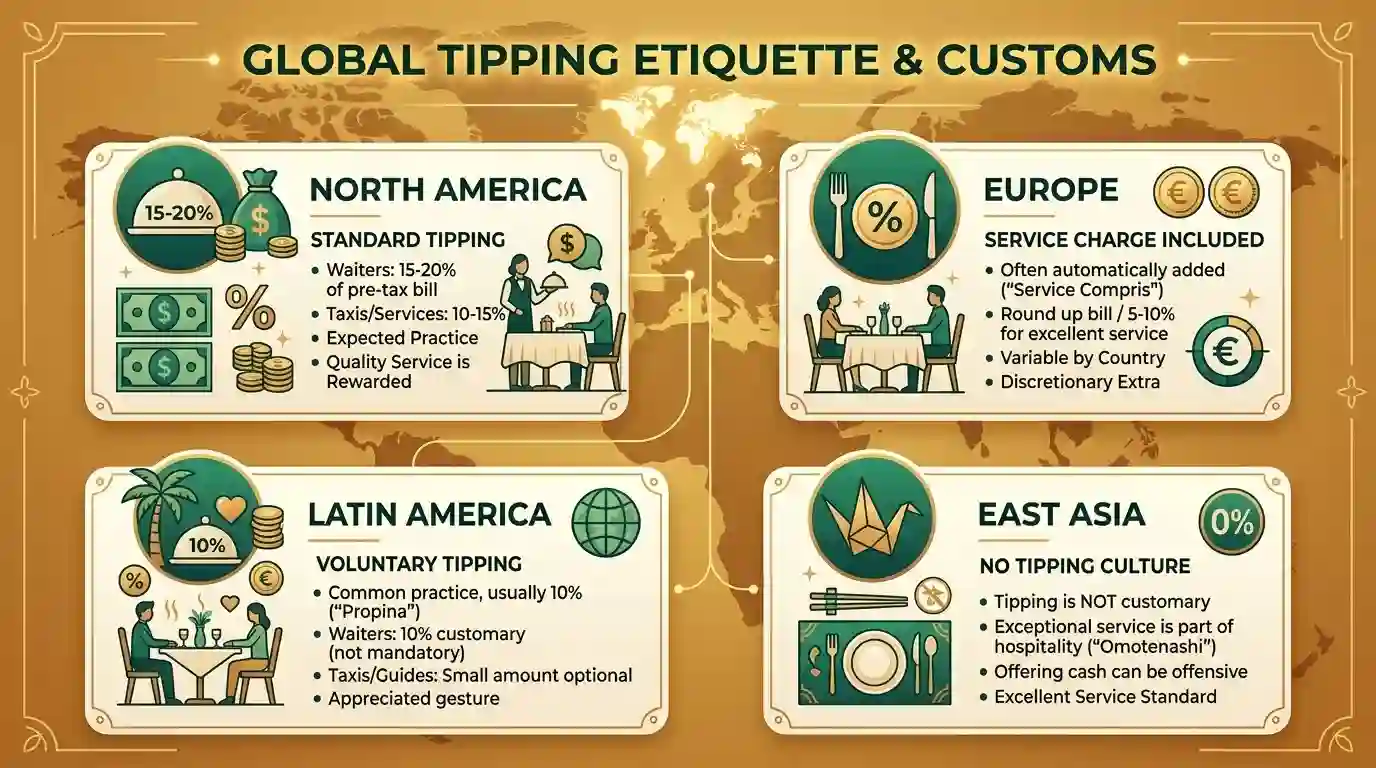
Tipping etiquette extends far beyond traditional sit-down restaurants. Below is our comprehensive benchmark table outlining standard North American gratuity ranges across diverse service sectors:
| Service Sector | Standard Tip Range | Norm & Expectation | Etiquette Guidelines & Exceptions |
|---|---|---|---|
| Full-Service Dining (Sit-Down) | 18% – 22% | Customary / Essential | 15% for acceptable service; 20%+ for attentive or upscale dining. Calculated on pre-tax subtotal. |
| Casual Buffets | 10% – 15% | Appreciated | Compensates waitstaff for drink service, clearing plates, and maintaining dining cleanliness. |
| Bars & Bartenders | $1 – $2 / drink or 18%–20% | Customary | $1 per poured beer/wine; $2+ for craft shaken cocktails. 20% on open cocktail tabs. |
| Food Delivery (DoorDash, Uber Eats) | 15% – 20% ($4–$5 min) | Essential | Drivers utilize personal vehicles and fuel. Increase tip to $7–$10 during severe rain, snow, or peak rush. |
| Coffee Shops & Baristas | Change to $1 per drink | Discretionary | Not strictly obligatory for drip coffee; polite and appreciated for labor-intensive espresso latte art. |
| Rideshare & Taxis (Uber, Lyft) | 10% – 15% | Standard | Increase to 20% if the driver assists with heavy luggage or navigates extreme traffic delays. |
| Hotel Bellhops / Porters | $2 – $3 per bag | Customary | $5 minimum for luxury hotel delivery or excessively bulky luggage brought directly to room. |
| Hotel Housekeeping | $3 – $5 per night | Highly Recommended | Leave cash daily in a clearly marked envelope, as daily housekeeping staff rotates regularly. |
| Hair Stylists, Barbers & Spas | 15% – 20% | Customary | Tip on the full pre-discounted service price. A separate $3–$5 cash tip is customary for shampoo assistants. |
| Valet Parking | $2 – $5 | Customary | Paid in cash upon retrieval of the vehicle. Premium vehicles or swift retrieval warrant $5. |
Group Dining Dynamics: Equal Split vs. Itemized Bills
Splitting a dining check among friends or colleagues frequently triggers social discomfort. Choosing between an equal division and an itemized split depends on order symmetry:
- When to Split Equally: When all diners ordered comparable entrees, shared appetizers, and consumed similar beverages, an equal division is fastest and most collegial. Our calculator’s Round Per Person Up button rounds each share to the next clean dollar, making cash collection or Venmo/Zelle requests completely effortless.
- When to Itemize: When significant order disparities exist—such as when one diner consumed expensive vintage wine while another had water and a side salad—the diners who consumed alcohol should voluntarily cover the drinks tab plus its corresponding tax and tip, leaving food costs to be shared proportionally.
- Auto-Gratuity for Large Parties (IRS Revenue Ruling 2012-18): Most restaurants automatically attach an 18% to 20% "Auto-Gratuity" or "Service Charge" for parties of 6 or more. Under IRS regulations, automatic mandatory gratuities are legally classified as service wages paid to the restaurant and redistributed to staff, rather than discretionary customer tips. Always inspect the itemized receipt before adding additional tip to avoid double tipping!
North American Labor Laws & The Fair Labor Standards Act (FLSA)
In the United States, restaurant tipping is intrinsically linked to federal and state wage statutes. Under the Fair Labor Standards Act (29 U.S.C. § 203(m)), employers are permitted to take a "Tip Credit," paying tipped employees a direct cash wage as low as $2.13 per hour, provided the employee's combined tips bring their total earnings up to the federal minimum wage ($7.25/hour). If tips fall short, the employer is legally obligated to fund the difference.
However, seven states have completely eliminated the tip credit system: California, Washington, Oregon, Nevada, Minnesota, Montana, and Alaska. In these states, waitstaff receive the full statutory state minimum wage (often $15.00 to $16.50+/hour) in addition to all customer gratuities. While tipping 18%–20% remains standard dining etiquette nationwide, understanding these regional labor variations provides valuable context for informed diners.
FAQs
In US full-service restaurants, the standard tipping benchmark is 18% to 20% of the pre-tax food and beverage subtotal. For exceptional service, 22% to 25% is common, while 15% is considered the absolute baseline for minimally acceptable service.
Etiquette experts (including the Emily Post Institute) unanimously advise tipping on the pre-tax subtotal. Sales tax is a mandatory government revenue fee, not an indicator of waitstaff service quality. Tipping post-tax increases your cost by an extra 1.5% to 2.5%.
It rounds each individual diner's share up to the nearest whole currency unit (e.g., $47.33 becomes $48.00). This eliminates loose pocket change, simplifies peer-to-peer digital transfers via Venmo or Cash App, and provides a small extra gratuity bonus for the server.
Under IRS Revenue Ruling 2012-18, automatic gratuities (often 18% on parties of 6 or more) are legally considered service charges rather than discretionary tips. Always review your itemized bill; if an auto-gratuity is already added, you do not need to add an additional tip unless the service was extraordinary.
Tipping for takeout is voluntary. While waitstaff or baristas may pack and garnish your food, they are not providing continuous table service. A tip of 10% or $2 to $3 in the tip jar is a polite gesture of appreciation, but not mandatory.
A minimum tip of $4 to $5, or 15% to 20% of the order value (whichever is greater), is recommended. Delivery drivers bear significant personal expenses, including vehicle depreciation and gasoline. In bad weather or during peak traffic, tipping $7 to $10 is customary.
Yes! Clicking our 'Copy Split Summary' button generates a formatted text receipt containing the total bill, tip amount, individual diner count, and each person's exact share, ready to paste into WhatsApp, iMessage, or group chats.
Hospitality & Legal Disclaimer
This calculator provides estimates based on prevailing dining etiquette and statutory rules. Gratuity policies, mandatory service charges, and sales tax regulations vary by state, municipality, and establishment.